How I Write Math Contest Problems
some thoughts I've collected over the years

I organize UVAMT, the University of Virginia Math Tournament, and I’ve written most of the problems for the past two years. Naturally, this has given me a lot of thoughts about the problem-writing process.
one - theory
Here’s a problem I’d consider bad for a contest:
Consider a 6x6 square grid of cells. How many distinct paths are there from the lower-left to the upper-right cell that only go up or right?
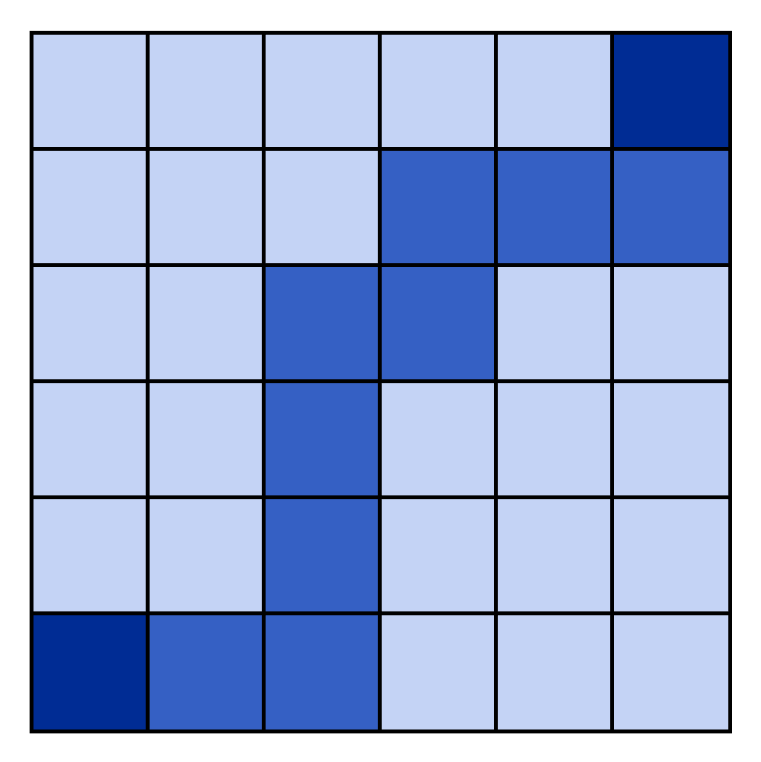
If you’re a seasoned math competitor, you might not immediately see the issue: you’d find it straightforward, and that’s how it should be for you. The issue is, if you don’t know how to solve it, you’re unlikely to find the trick1 in-contest, and if you do, you’ve probably seen something like this before and can get it without needing much clever thinking. In other words, there’s no skill level at which this problem feels particularly satisfying to solve. Either you know it, or you don’t.
Contrast it with this UVAMT problem from last year:
Vincent has 6 buckets, with capacities 2, 3, 4, 5, 6, and 7 pounds. He also has 6 bricks, weighing 1, 2, 3, 4, 5, and 6 pounds. He wants to put exactly one brick in each bucket such that no bucket is above capacity. How many ways are there for him to accomplish this? (UVAMT 2025, Individual #6)
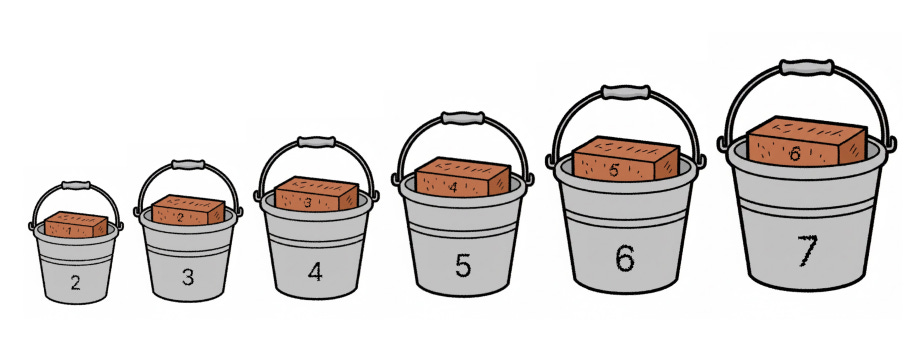
If you’re a seasoned competitor, this problem should be equally straightforward. The difference is, even if you don’t immediately see the solution2, this problem invites you to play with it, try different combinations, and discover things about the setup. You actually have a fighting chance of figuring it out yourself, and you’d actually have fun thinking about it, rather than banging your head against the wall. This problem actually has a reasonably wide range of skill levels for which solving this problem would feel earned, something to be proud of, something that makes you feel smart once you see it.
The reason why this is tricky is because if you’re a problem writer, you’re most likely able to solve the hard problems, so the easy ones will all seem equally straightforward. You can’t just use your own judgement, as that only works for evaluating problems at your skill level: you have to put yourself in the mindset of someone who knows less than you, a much more difficult task. But it’s an important one: easy problems are meant for newer competitors, so they should still feel fun and interesting to them.
The other major issue I was wary of was making the easy problems too hard. Evan Chen has written about this already, but the point is, if you’re a new competitor, you show up, and only solve 1 problem on the individual round, you probably weren’t having a very good time, and might be discouraged from trying math in the future. Sure, as a problem writer, the hard problems tend to be the most interesting! But it’s easy to underestimate how difficult they actually are (after all, you already know the trick, and they don’t). The easy problems are meant for the newer competitors, and they should be having fun too. I’ve found that for a 10- to 15-problem contest, I have to shift the difficulty around 2 problems in the easier direction to get the actual difficulty I want.
Hard problems are generally easier to write, since you can just follow what’s interesting to you. However, the point about avoiding problems where “either you know it or you don’t” remains. I try not to have my hard problems rely on having too much background, because it’s nice if competitors who get to the hard problems actually feel like they can make progress, and once the contest is over, feel like they could have found the solution if they were clever enough. (I also find hard problems of this sort more elegant in the first place.)
Basically, each problem can be thought of as having a skill floor (the minimum skill level required to make some progress and feel like you could solve it), and a skill ceiling (above which the problem becomes straightforward).
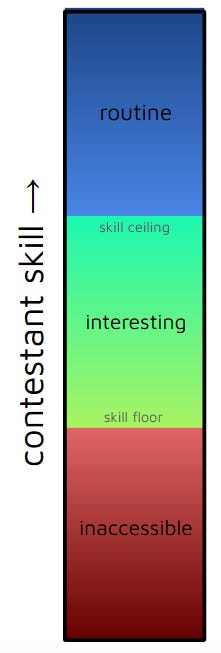
This means the quality of a problem roughly depends on how many competitors lie between its skill floor and skill ceiling. Good easy problems have a very low skill floor, perhaps even understandable by laypeople, while still requiring some thought. Good hard problems are unique enough that they require ingenuity even for competitors who have seen thousands of other problems before, and ideally still accessible to those without quite that level of experience.
two - practice
Now, how do I actually write these problems? You can get pretty far just drawing inspiration from other contests, but I’ve found that my best problems come from thinking about the real world:
You’re driving a go-kart without gas or brakes - just a steering wheel. The go-kart travels in arcs of radius 1, and you can instantaneously change the direction of its arc between clockwise and counterclockwise, but this is all the control you have. You’re currently at point A traveling due north. What’s the minimum distance you must travel to return to point A traveling due south? An example of the go-kart’s movement pattern is given below. (UVAMT 2025, Team #14)
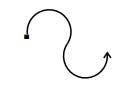
The inspiration for this problem was actually thinking about those toy train tracks that you can put together in curves. In particular, what are some nontrivial aspects of them? Making a U-turn comes to mind. You can’t just rotate in place; you actually have to travel some distance to execute the turn. This distance depends on how tight of a turn you can make. So I set that to be constant, abstracted away the other details, and turned it into this problem. Understandable by someone with little math background, very easy to play with, but very difficult to find the solution3 despite it not needing much heavy mathematical machinery.
The same concept applies on the easier end:
On a table, some coins are placed in a row, each showing heads or tails, such that:
Exactly 3 coins are showing tails,
Each tail is adjacent to two heads, and
Each head is adjacent to exactly one other head.
How many coins must there be on the table in total? (UVAMT 2025, Team #1)
Funnily enough, this problem was inspired by an article I read, claiming that large language models had trouble4 solving this sort of constructive logic puzzle. So, I thought about conditions that could make for an easy math-flavored puzzle of this sort while still requiring a bit of cleverness. I’ve seen some problems before involving coins in a line, and that led me to this construction. Although the problem isn’t too hard, you do still need to do a bit of work to solve5 it, and it’s surprisingly easy to mess up if you aren’t careful. The point is, inspiration can come from the most unexpected of places, and the more unusual, the better!
three - putting it together
Writing the problems is the hardest part, but there’s still more to it. When finalizing the contest, I kept all of the following points in mind:
Problem clarity
Problem quality
Difficulty curve, subject distribution
Note that this is an ordered list. Problem clarity actually comes first: it doesn’t matter how high-quality your problem is if you have to throw it away due to it being ambiguous or ill-formed. You really want to avoid having competitors come up to you petitioning that their answer was technically correct because you forgot to specify some tiny detail, and having to change all the rankings. It also doesn’t matter if you have a perfect difficulty curve and subject distribution if the problems are unpleasant to work on: the competitors will end up with a bad experience anyway.
Once the first two points are solid, then it’s time to think about the last one. I used a table to organize which types of problems I had so far:
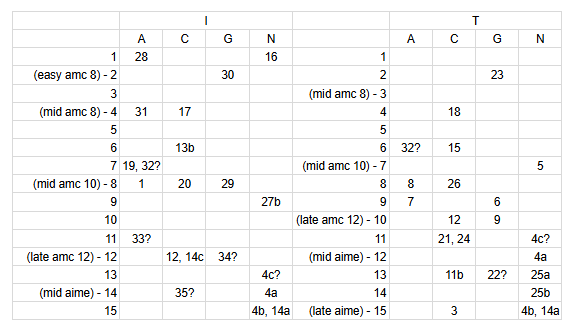
I assigned problems to Individual or Team based on whether the problem lent itself to having multiple helpers (e.g. multi-step problems, or problems using a specific technique not everyone would know). From this, I could immediately tell that I needed more easy Algebra and Number theory problems on Team round, as well as more hard Algebra problems, so I could shift my problem-writing efforts there.
It’s especially important to have a balanced distribution on the harder end of the Individual round, since those are the questions that set apart the individual winners from the runner-ups. For instance, I’d avoid placing both Problem 12 and Problem 14c on the Individual round, as they’re a similar flavor of Combinatorics, both at the same difficulty level.
These considerations meant that I needed to write 1.5 to 2 times as many problems as I would actually end up using, because I’d often run into issues where I had too many problems of a certain difficulty, and not enough of others. Of course, I also had to make sure that these new problem were as high-quality as the ones they were replacing, so it actually took a while to finalize the test even after I technically had written enough problems.
In total, I spent around 100 hours writing problems for last year’s contest, and even more for this year’s. But I do it because I care. I want people to come to my competition and see for themselves just how fun math can be, when it’s done well.
We’re holding UVAMT 2026 on 3/14 at the University of Virginia. Check out our website if you’re interested!
The trick is to fill in each cell with the number of ways to get to it from the start using only legal moves. This is just 1 for all cells on the left or bottom. For all other cells, add the number below it and the number to the left (because every path to that cell must go through one of those two options). Once everything is filled, this gives us our answer of 252 in the top-right cell.
Actually, I’m not going to spoil this one here. Try it yourself! If you really want, all the solutions are on the website.
I’m not spoiling this one either. This one’s hard, but it’s so good.
All the major LLMs get it now. But it took a surprisingly long time to get to this point.
Come on, I know you can do this one yourself. Just try it!
skill floor + skill ceiling is an interesting perspective. in our national olympiad, we often consider difficulty + instructiveness, which i think is a different way to factor the same thing? (perhaps it's min + max vs. median + range?) though, we also consider some notion of elegance/beauty, or "how much it makes you want to work on it". that one feels so difficult to write for though
never a problem to end up with too many problems imo, more for next year's shortlist